
Why More Salt and Standing Slowly Is Not the Whole POTS Story
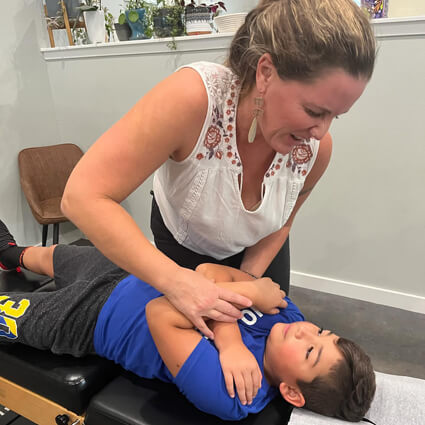 If your teen has been diagnosed with POTS, or Postural Orthostatic Tachycardia Syndrome, you already know how dramatically it can change everyday life.
A kid who was once active, independent, and full of energy may suddenly struggle just to stand without their heart racing. School becomes exhausting. Sports and activities disappear from the schedule. Migraines, dizziness, fatigue, and brain fog can make even simple tasks feel overwhelming.
And often, families are given advice like:
“Drink more water.”
“Increase salt.”
“Stand up slowly.”
Those things may help manage symptoms, but for many families, they do not answer the bigger question:
Why is the body struggling to regulate itself in the first place?
At Rooted Wellness Chiropractic, that is where we start looking more closely at the nervous system.
Tommi’s Story
Tommi was 17 years old, active, athletic, and thriving.
She rode horses. She cheered. She was an A-B student with plans for her future.
Then POTS changed everything.
Her mom described overwhelming fatigue that kept Tommi in bed for much of the day, along with migraines, brain fog, tachycardia, low blood pressure, chest pain, insomnia, anxiety, and depression.
At her worst, even walking to the bathroom could end with her passing out.
Her junior year became less about school, friends, and activities and more about simply getting through the day.
Her family tried the typical approaches to POTS care, but they continued searching because they knew there had to be more to the story.
Eventually, they found Neurologically Focused Chiropractic Care.
As Tommi’s nervous system began to respond to care, her family started seeing changes. She was able to return to cheering, riding horses, and living the active life she had lost.
Today, she is heading to college on scholarship and has even been inspired to pursue a future in nervous system-focused chiropractic care.
Every person’s story is different, but Tommi’s experience shows why looking beyond the symptoms can matter.
POTS and the Autonomic Nervous System
POTS involves much more than a racing heart.
Kids and young adults may experience:
- Dizziness or lightheadedness
- Fainting or feeling like they may faint
- Rapid heart rate
- Low blood pressure
- Extreme fatigue
- Migraines
- Brain fog
- Digestive changes
- Exercise intolerance
- Sleep disruption
- Anxiety or feeling constantly on edge
The common thread behind many of these symptoms is the Autonomic Nervous System.
This part of the nervous system controls all of the functions your body is supposed to handle automatically, including heart rate, blood pressure, digestion, temperature regulation, and much more.
When that system is having difficulty adapting and regulating, symptoms can show up throughout the entire body.
This pattern of altered autonomic regulation is called dysautonomia.
And that is why, at Rooted Wellness Chiropractic, we believe the nervous system deserves a much closer look.
Why the Vagus Nerve Matters
The vagus nerve is one of the most important nerves involved in regulation.
It begins in the brainstem and travels throughout the body, communicating with the heart, lungs, digestive system, and other major organs.
It plays an important role in helping the body shift out of a constant stress response and into a state where it can rest, digest, recover, and regulate.
When the sympathetic, or “fight or flight,” side of the nervous system becomes dominant, even relatively small stressors can create a big response.
Standing up.
Heat.
Exercise.
Illness.
Emotional stress.
A busy day at school.
For a teen already struggling with POTS, those everyday demands can feel enormous.
That is why supporting better autonomic balance and vagal tone becomes such an important part of the neurological conversation.
The Perfect Storm Behind POTS
POTS does not always have one simple starting point.
For many families, there has been a collection of physical, chemical, and emotional stressors that built over time before symptoms became impossible to ignore.
We often call this the Perfect Storm.
That story may include things like:
- Birth trauma or physical stress early in life
- Repeated illnesses or infections
- Viral illness such as mono or COVID
- Autoimmune challenges
- Ehlers-Danlos Syndrome or MCAS
- Chronic emotional stress
- Injuries or concussions
- Ongoing postural stress
- Years of nervous system dysregulation
Sometimes one final stressor seems to push the system past the point where it can continue compensating.
That is often when families feel like everything changed overnight.
But from a nervous system perspective, the story may have been building for much longer.
Why Managing Symptoms May Not Feel Like Enough
Hydration matters.
Electrolytes matter.
Salt can matter.
Moving slowly when changing positions can matter.
Medication may also be part of a child’s care plan.
Those tools can all have an important place.
But many parents still find themselves asking:
What is happening underneath all of this?
If the nervous system is struggling to regulate heart rate, blood pressure, digestion, temperature, sleep, energy, and stress responses, simply chasing each individual symptom can feel exhausting.
That is why we take a neurological approach.
Instead of looking only at what symptoms are showing up, we want to understand how well the nervous system is adapting and regulating as a whole.
How We Assess the Nervous System at Rooted Wellness Chiropractic
At Rooted Wellness Chiropractic, we use INSiGHT neurological scans to help us better understand what is happening within the nervous system.
These scans give us objective information about patterns of neurological stress and regulation using technologies such as:
- Heart Rate Variability, or HRV
- Surface EMG
- NeuroTHERMAL scanning
Together, they help us build a clearer picture of how the autonomic nervous system may be functioning.
We do not want to simply guess.
One of the things we say often in our office is:
You can’t claim to change what you’re not measuring.
Neurologically Focused Chiropractic Care and POTS
Neurologically Focused Chiropractic Care looks beyond aches, pains, and posture alone.
Our goal is to identify areas of neurological stress, often referred to as subluxation, that may interfere with the nervous system’s ability to adapt and regulate efficiently.
Through gentle and specific chiropractic adjustments, we work to support the neurospinal system and improve the body’s ability to move toward greater balance and adaptability.
For a teen dealing with POTS, this does not mean ignoring hydration, nutrition, movement, sleep, medications, or their other healthcare providers.
Those things can all remain important pieces of the puzzle.
Neurologically Focused Chiropractic Care simply offers another way to support the foundation underneath them: the nervous system itself.
Your Teen Deserves More Than Symptom Management
Watching a teenager lose pieces of their life to POTS can be incredibly difficult.
School.
Sports.
Friends.
Independence.
Confidence.
The things that once seemed ordinary can suddenly feel impossibly far away.
If your child is struggling with dizziness, fainting, tachycardia, fatigue, migraines, brain fog, or a POTS diagnosis, there may be more of their nervous system story worth exploring.
At Rooted Wellness Chiropractic in Mansfield, Texas, we take the time to look at that bigger picture.
We listen to your child’s full story.
We measure how their nervous system is functioning.
And we create care based on what their individual nervous system is showing us.
If you are ready to learn more about what may be happening beneath your child’s symptoms, reach out to Rooted Wellness Chiropractic to schedule a neurological assessment.
Because your child deserves more than simply learning how to live around their symptoms. They deserve the opportunity to understand what their nervous system has been trying to tell them.
CONTACT US